
Short answer: Yes. If you've spent months grinding puzzles on apps or playing blitz games online without seeing your rating budge, an AI chess robot coach can break the cycle. With major online platforms now hosting hundreds of millions of registered users, millions of players are stuck practicing daily yet plateauing hard. The missing piece isn't more screen time—it's SenseRobot, which forces your brain to process the game the same way real tournament play does.
For a complete overview of the AI chess robot landscape, check out our Ultimate Guide to AI Chess Robots.
For a complete overview of the AI chess robot landscape, check out our Ultimate Guide to AI Chess Robots.

Why Most Online Players Plateau
(and Why SenseRobot Changes That)?
SenseRobot changes the plateau problem. It forces your brain to process the game the same way tournament play does: by calculating on a physical board, without the crutches of digital hints and premove shortcuts.
Screen-based training creates what cognitive scientists call a "tactile-temporal gap." You recognize patterns on a screen, but you don't build the spatial memory or calculation discipline that over-the-board (OTB) play demands. When you sit across from a real opponent at a club or tournament, the board looks different. The pieces feel different. Your brain—trained on 2D screens—struggles to adapt.
Here are the 3 core reasons why online players plateau, and how SenseRobot fixes each one:
1. Screen illusion vs. board reality
Solving puzzles on a phone builds pattern recognition, not board vision. SenseRobot forces you to track piece relationships in 3D space. Studies show that physical manipulation during learning improves retention by up to 40% compared to screen-only observation.
2. Speed addiction vs. depth training
Online blitz rewards speed over calculation. Physical play rewards deliberate thinking. Research into amateur games below 2200 Elo reveals that 8 out of 10 decisive errors are tactical, not opening-related. These are calculation lapses born from rushed thinking—not knowledge gaps.
3. Motivational fade vs. tactile engagement
Watching a physical arm pick up a piece, move robotic chess pieces across the board, and gently set them down creates a sense of occasion that a glowing screen can't replicate. It turns practice into an event you look forward to.

Online Training vs. SenseRobot Training: At a Glance
|
Factor
|
Online Platforms
|
SenseRobot
|
|---|---|---|
|
Board awareness
|
2D screen; no spatial depth
|
3D physical pieces; full spatial mapping
|
|
Calculation discipline
|
Premove shortcuts; take-backs common
|
No digital aids; pure mental calculation
|
|
Time pressure learning
|
Blitz culture rewards speed
|
Adjustable pace; forces depth
|
|
Tactile memory
|
None
|
Piece weight, movement, placement all registered
|
|
Motivation sustainability
|
Notification-driven; dopamine loops
|
Event-driven; ritualistic engagement
|
What an AI Chess Robot Coach Actually Teaches You?
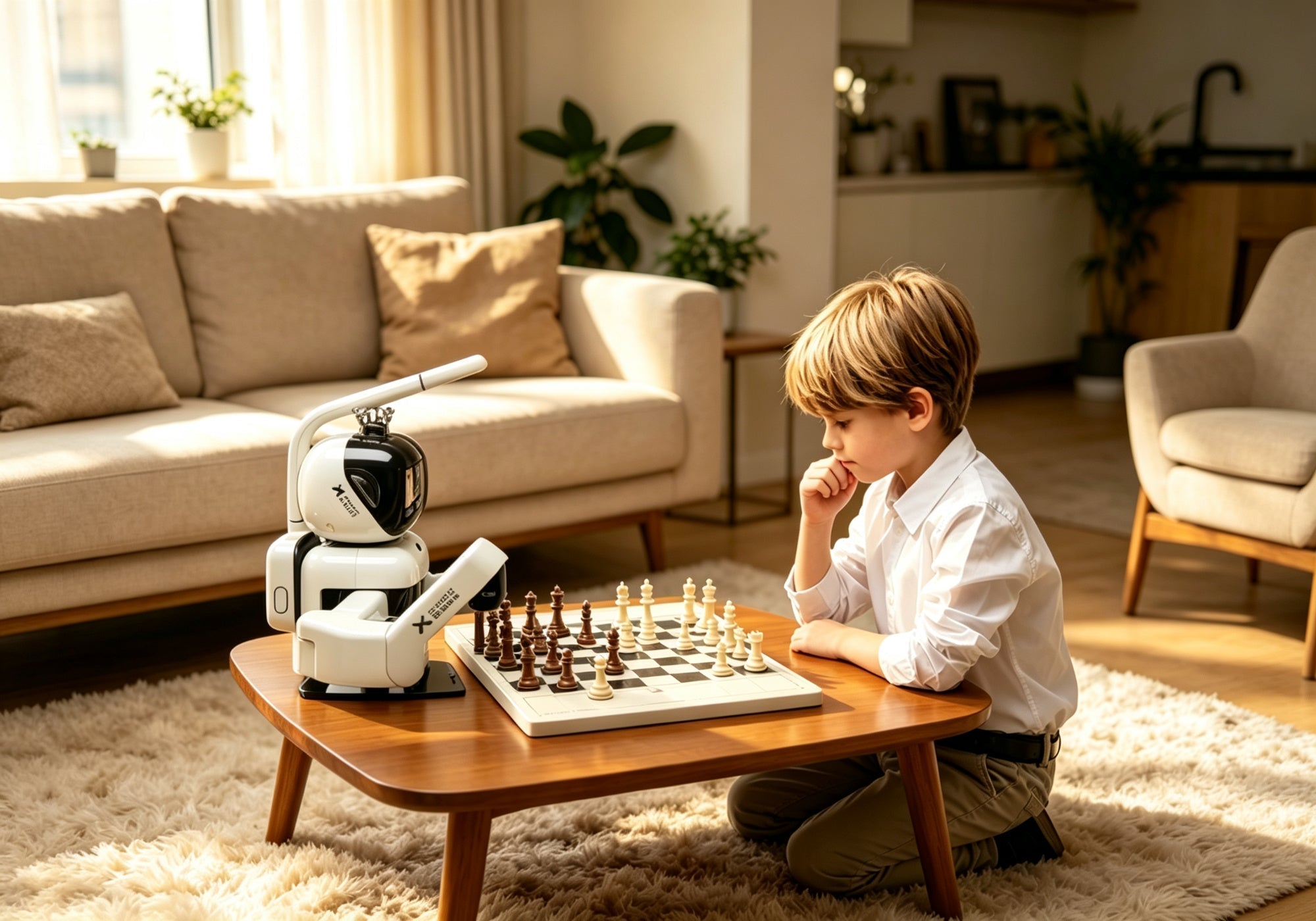
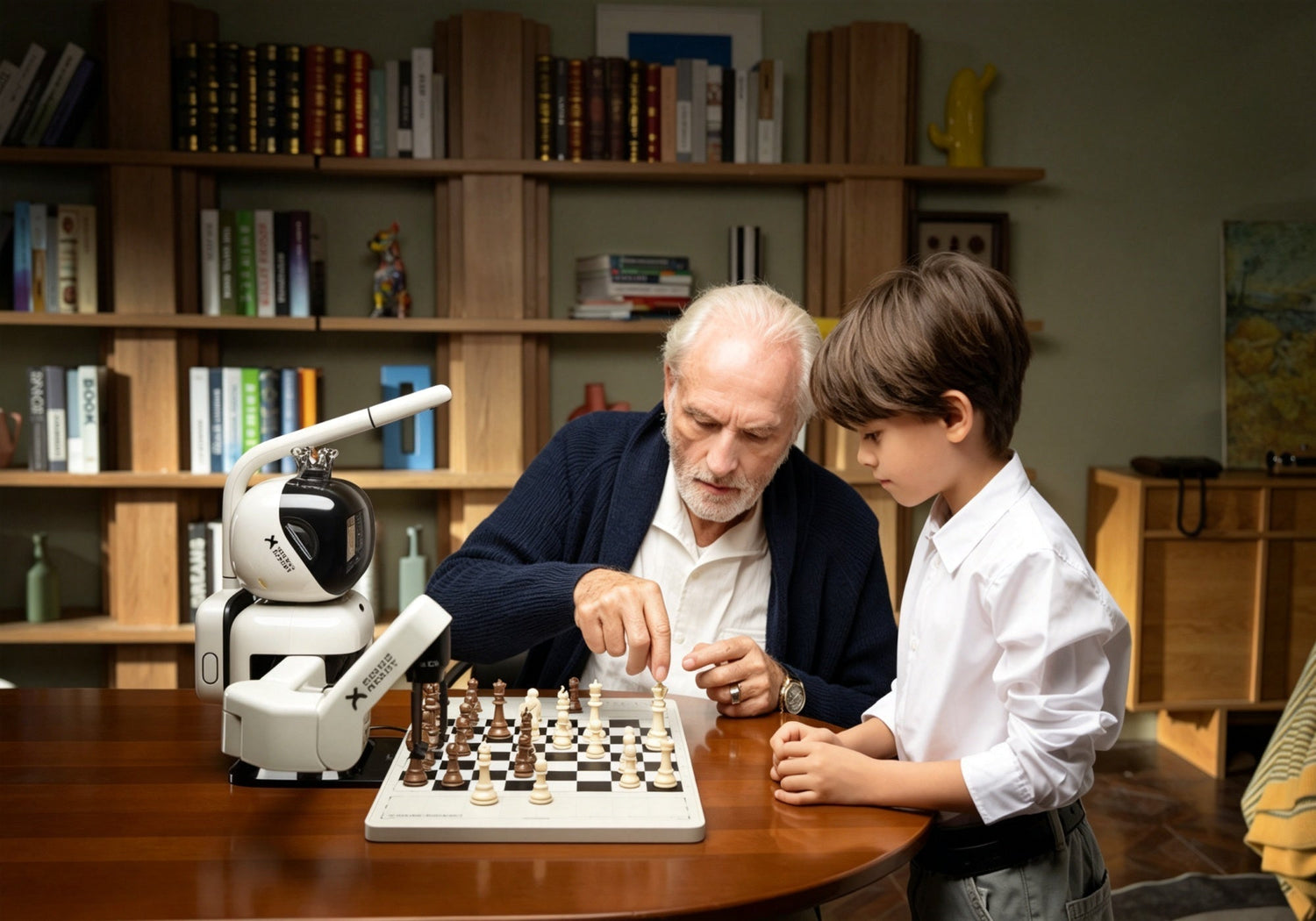
An AI chess robot coach differs from apps and human coaches by giving you the consistency of a chess engine, the structured curriculum of a trained instructor, and the tactile reality of a real opponent—all in one device that lives on your coffee table.
Unlike playing against a weakened Stockfish bot, a well-designed chess robot doesn't just make random blunders to simulate weakness. It scales intelligently. Here is the 4-layer teaching framework that separates a real chess robot coach from a toy:
Layer 1: Adaptive difficulty that meets you where you are
SenseRobot offers 25 adaptive AI levels spanning Elo 200 to 2900, plus an "Apex Duel" mode rated above 3200. The same machine teaches your child the basics and later pushes you—the club player—to your absolute limit. It gets harder as you improve, with no ceiling.
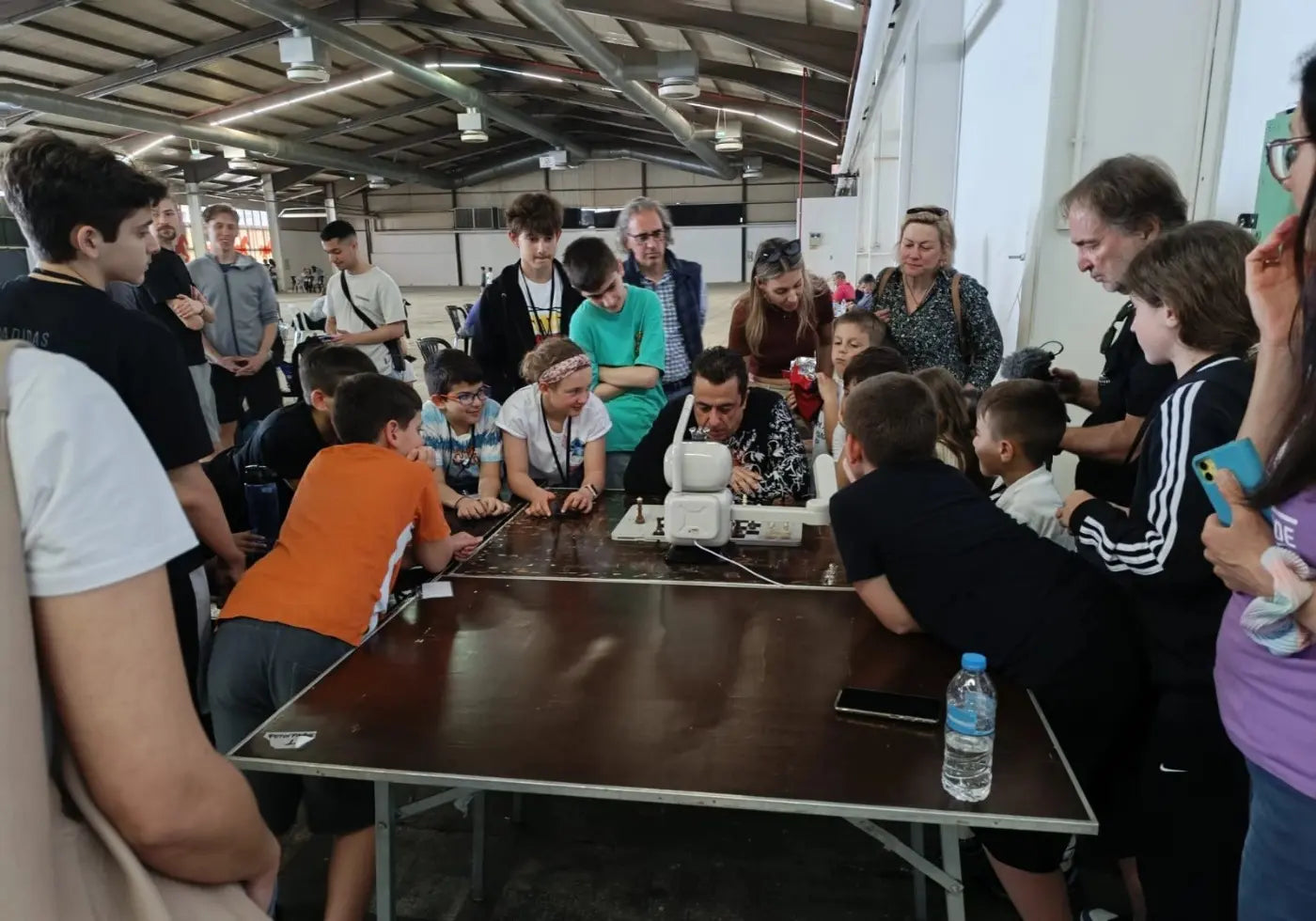
The strength isn't theoretical. In a highly anticipated match, SenseRobot's AI defeated four-time Women's World Chess Champion Hou Yifan. When a machine can outplay a Grandmaster rated 2633, you know the training ceiling is high enough for any home player.
Layer 2: Physical demonstration of tacticsInstead of passively watching a video of Morphy's Opera Game, you see the pieces actually move. SenseRobot physically executes pins, forks, and skewers on a real board. You don't just "see" the tactic—you feel it. Watching a chess robot physically move robotic chess pieces across the board converts abstract knowledge into muscle memory.

Layer 3: Structured curriculum, not just games
1,200+ curated exercises,145 classic endgame positions,100 masterpiece games replayed move by move with physical pieces. SenseRobot resets positions automatically. It replays key endgames until you internalize the technique. It's a syllabus, not just a sparring partner.
Layer 4: Economics that scale in your favorPrivate chess coach rates in the United States typically run between $50 and $150 per hour. A premium SenseRobot costs around $999 as a one-time investment. After roughly 10 to 20 hours of use, you've already broken even—and SenseRobot never cancels, never has a bad day, and is available at 11 PM when inspiration strikes.
What You Get: Human Coach vs. SenseRobot vs. Chess App
|
Capability
|
Human Coach
|
Chess App
|
SenseRobot
|
|---|---|---|---|
|
Adaptive opponent
|
❌ (needs scheduling)
|
✅ (always available)
|
✅ (always available)
|
|
Structured curriculum
|
✅
|
⚠️ (varies by app)
|
✅ (built-in)
|
|
Physical board experience
|
✅
|
❌
|
✅
|
|
Instant feedback
|
⚠️ (delayed)
|
✅
|
✅
|
|
Cost over 1 year
|
$2,600–$7,800
|
$0–$120
|
~$999 (one-time)
|
|
Availability
|
1–2 hrs/week
|
Unlimited
|
Unlimited
|
|
Tactile learning
|
✅
|
❌
|
✅
|
Beyond the Board: STEAM Education & AI Companionship
SenseRobot isn't limited to chess drills. It doubles as a STEAM education platform with integrated card-based programming, teaching logic and sequencing through hands-on play. Its multi-scenario AI conversation capabilities mean it can discuss strategy, explain concepts, or simply chat—turning a solo training session into an interactive experience. For families, this extends the device's value from a single-purpose chess trainer to a broader learning companion.
Is SenseRobot Worth It for Your Home Training Setup?
For most U.S. chess enthusiasts, SenseRobot is worth it if you prioritize four specific factors. Miss any one, and you're buying a toy. Get all four right, and you're buying a training partner that lasts years.
Use this 4-factor evaluation framework when comparing models:
Factor 1: Mechanical precisionSenseRobot handles delicate Staunton pieces thousands of times. If the arm lacks accuracy, pieces tip over, games get interrupted, and frustration builds. Look for sub-1mm precision and 99%+ vision accuracy. The best SenseRobot models achieve 99.9% AI vision accuracy with sub-1mm mechanical precision—specifications drawn from aerospace-grade engineering.
This isn't accidental. SenseRobot is built on 40+ patents and two decades of R&D, refined through 8 major design iterations. Industrial robotic arms with comparable precision typically cost $40,000. Consumer models like SenseRobot achieve this at roughly 1/40 the cost.
Factor 2: Curriculum depthThe device should explain why a move works, not just execute it. Evaluate:
· Exercise library size (1,000+ is the benchmark)
· Endgame database coverage
· Classic game archives with physical replay
· Hint and teaching modes (not just "play" mode)
· Endgame database coverage
· Classic game archives with physical replay
· Hint and teaching modes (not just "play" mode)
Factor 3: Safety engineeringThis matters more than most reviews discuss. The best models incorporate 30+ built-in sensors and soft-gripper technology tested on fragile objects. SenseRobot's gripper is gentle enough to handle a quail egg without cracking it. If you have children or pets, this isn't a nice-to-have—it's essential.
Factor 4: Online platform integration
Direct online platform connectivity means you can play against human opponents worldwide while SenseRobot physically moves their pieces on your board. You get the global competition of online chess with the tactile experience of OTB play. Without this, your opponent pool is limited to the built-in AI.
Frequently Asked Questions (FAQs)
· Can an AI chess robot coach really replace a human chess coach?
For players below 1800 Elo, a well-designed chess robot coach covers roughly 80% of what a human chess coach provides: structured exercises, adaptive opponents, instant feedback, and repetition on demand. Above 1800, human coaches still add unique value for opening repertoire refinement and psychological preparation. Think of SenseRobot as your daily practice partner and the human coach as your monthly strategist.
· What skill level is SenseRobot best suited for?
Premium robots with 25+ adaptive levels—like SenseRobot's range from Elo 200 to 3200+—serve everyone from absolute beginners learning how the knight moves to competitive club players preparing for rated tournaments. The key is adaptive scaling: SenseRobot gets harder as you improve.
· Is SenseRobot safe for children?
Leading models use 30+ sensors and soft-gripper designs specifically engineered for safety. SenseRobot's gripper is tested to handle fragile objects without damage. That said, parental supervision is recommended for children under 8, as with any household device with moving parts.
· Does SenseRobot offer anything beyond chess training?
Yes. SenseRobot includes integrated card-based programming features that introduce STEAM education concepts through gameplay, making it a learning tool for logic and sequencing as well as chess. Its AI conversation capabilities also allow players to discuss strategy, ask questions, or engage in open-ended dialogue—extending its value beyond the 64 squares.
· How much should I budget for SenseRobot?
Entry-level electronic boards start around $130. Full-featured AI robotic coaches with mechanical arms, adaptive AI, and structured curricula range from $500 to $1,300. Given U.S. coaching rates of $50–$150 per hour, a $999 SenseRobot breaks even after about 10–20 hours of equivalent instruction.
Final Verdict
The chess boom isn't slowing down—major online platforms now have hundreds of millions of users combined. But popularity doesn't automatically mean improvement. If you've been stuck at the same rating for months, the problem might not be your effort. It might be your training environment.
An AI chess robot coach bridges the gap between convenient digital practice and the deep, tactile learning that over-the-board play demands. It gives you an opponent that scales with your skill, a curriculum that structures your study, and a physical board that forces your brain to calculate like it's tournament day.
Is it a magic bullet? No. You still have to put in the hours. But if you're going to practice anyway, you might as well practice in a way that actually transfers to real results. For serious chess enthusiasts ready to break through their plateau, SenseRobot isn't a novelty. It's a tool that earns its place on your table.