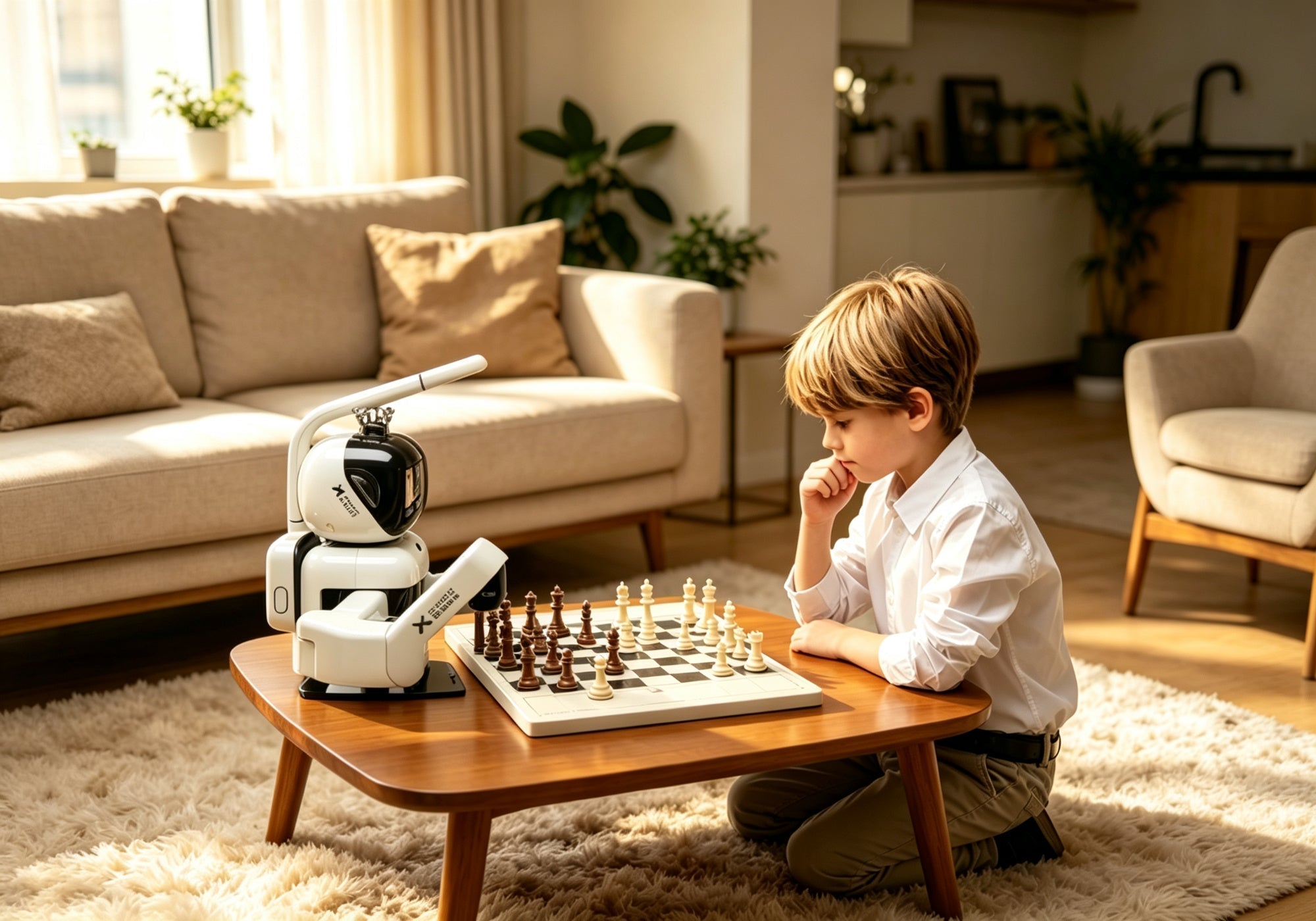

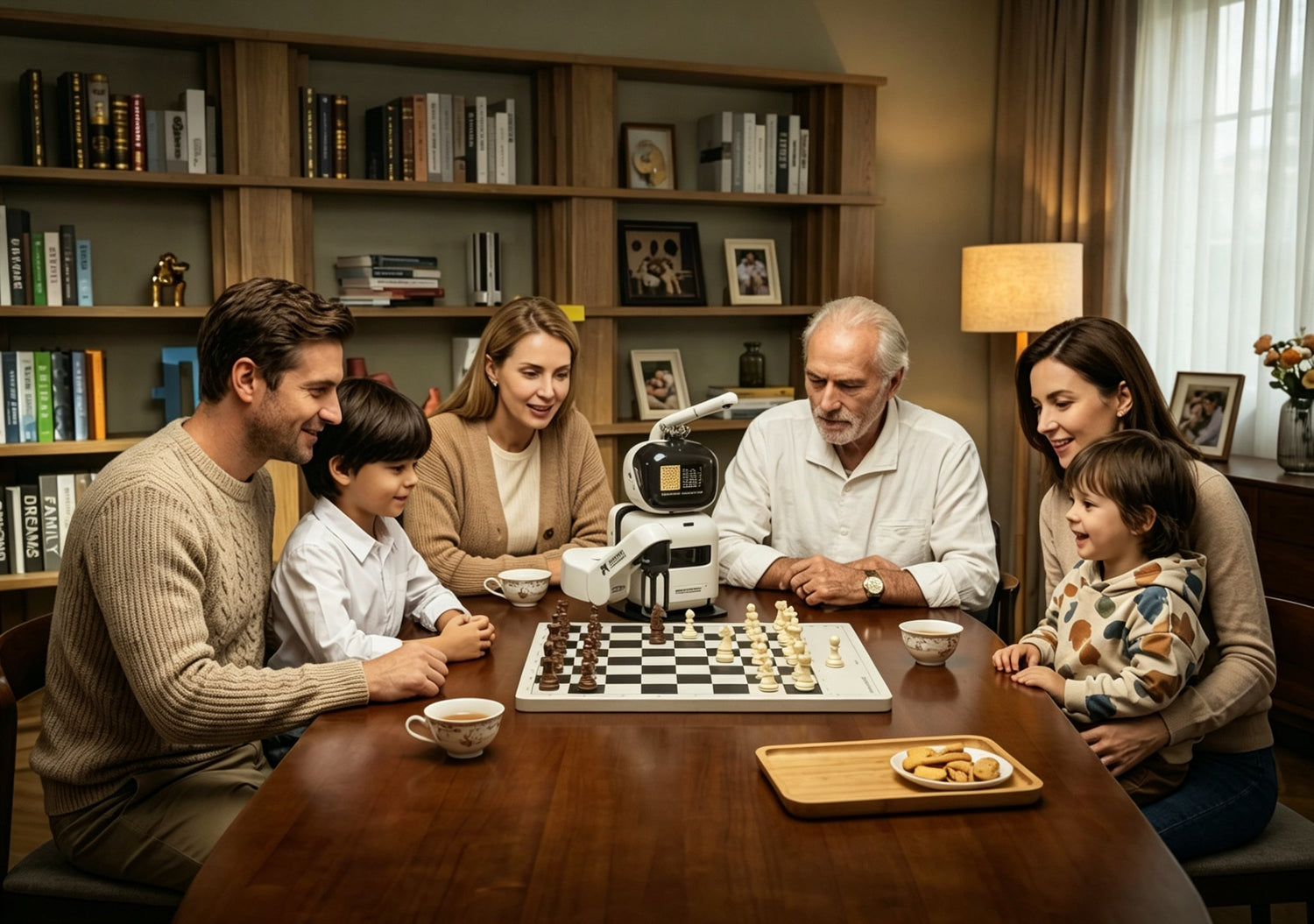
Over 600 million people worldwide play chess, but until recently, the vast majority have never sat across a physical board from a true Artificial Intelligence opponent. We live in an era where software engines have long surpassed human grandmasters, yet staring at a 2D screen often lacks the tactile magic and deep focus of a real over-the-board match. Enter the AI chess robot—a revolutionary fusion of robotics, machine learning, and classic gameplay that is transforming homes, academies, and tournaments globally.
But what exactly is an AI chess robot? Does the technology justify the investment? And with an influx of new smart boards hitting the market in 2026, how do you choose the right one for your family or chess club?
(For a complete step-by-step framework covering budget, age, and use-case scenarios, check out our full buying guide on How to choose the right AI chess robot.)
As the creators of SenseRobot, the world's leading AI-powered board game robot, we’ve compiled this ultimate hub guide. Whether you are a parent seeking a screen-free educational tool, an improving club player, professional chess player or a tech enthusiast, this guide will walk you through the mechanics, core values, and brand comparisons to help you navigate the ultimate AI chess board landscape.
1. What is an AI Chess Robot?
Answer-First: An AI chess robot is a physical, smart electronic chessboard equipped with integrated Artificial Intelligence algorithms and automated movement mechanisms (like robotic arms or magnetic sensors) that allow you to play a real, tactile game of chess against a computer without needing a screen.
The Evolution from Screen to Board
For decades, playing against "the computer" meant clicking a mouse or tapping a glass screen. While platforms like Chess.com or Lichess democratized the game, they stripped away the physical essence of chess—the weight of the pieces, the spatial awareness of a 3D board, and the screen-free focus required for deep calculation.
An AI chess board bridges this gap. When you make a move, sensors or overhead cameras register your play. The built-in AI engine calculates the optimal response, and the robotic arm physically executes that move right in front of you. (For a comprehensive overview of the engineering behind these devices, read our full guide on Can an AI Chess Robot Coach Really Improve Your Game.)
The 2026 Market Boom
Driven by advancements in consumer robotics and a renewed global interest in chess, the AI chess robot market has exploded. At events like CES 2026, AI robotics took center stage, with brands moving beyond simple smart boards into true robotic companions. Today, these devices are not just opponents; they are personalized coaches equipped with massive exercise databases, interactive voice AI, and global internet connectivity.
2. How Do AI Chess Robots Work?
Answer-First: AI chess robots operate on a continuous three-step loop:
· Perception :seeing the board via cameras or magnetic sensors
· Cognition :calculating the next move using a built-in AI engine
· Execution :moving the physical piece using a robotic arm or internal magnets
To understand the sheer engineering marvel behind these devices, we can break down the technology using the industry-leading SenseRobot architecture as the benchmark:
Step 1: Perception (Computer Vision vs. Magnetic Sensors)
How does the board know what you played? Traditional smart boards rely on hidden magnets and RFID chips inside proprietary pieces. If a piece is lifted and placed, the board registers the change. However, the most advanced robots in 2026 utilize overhead AI vision. SenseRobot employs a proprietary "Sense Vision + Occupancy Network" that visually recognizes 3D chess pieces with an astounding 99.9% accuracy. This means it sees the board exactly as a human does, requiring no special chips inside the pieces.
Step 2: Cognition (The AI Decision Engine)
Once the human move is registered, the AI must respond. Modern chess robots feature engines with highly adjustable difficulty levels. SenseRobot features 25 built-in AI levels ranging from an Elo rating of 200 (absolute beginner) to 2900 (Grandmaster), culminating in an "Apex Duel" mode that hits an Elo of 3200. The cognition engine isn't just about winning; it's programmed to play like a human at those specific levels, offering realistic and educational challenges.
Step 3: Execution (The Robotic Arm)
The final step is moving the piece. While some boards use internal magnetic rollers to drag pieces across the squares, robotic arms offer a truly futuristic experience. The aerospace-precision robotic arm on the SenseRobot boasts millimeter-level control accuracy. It is engineered with 30+ built-in sensors, making its gripper so dexterous and safe that it can pick up a fragile quail egg without crushing it.
3. The Core Value of AI Chess Robots
Answer-First: The primary value of an AI chess robot lies in its ability to provide screen-free educational development for children, relentless skill improvement for competitive players, and an interactive companionship that a flat screen simply cannot replicate.
Educational Value: Building the Leaders of Tomorrow
Chess is widely recognized as a phenomenal tool for cognitive development. However, parking a child in front of an iPad to play chess often leads to digital distraction and eye strain. An AI chess robot acts as a dedicated, physical tutor. With features like SenseRobot's 1,200+ curated chess exercises and 145 classic endgame modules, the robot guides students through structured lessons.
(Discover more about the pedagogical benefits on How AI Chess Robots Help Kids Learn Chess Faster)
Health and Companionship
In 2026, digital fatigue is a real concern. AI chess robots offer a "digital detox." They bring the magic of hands-on, tactile play back into the living room. Furthermore, for enthusiasts who struggle to find over-the-board opponents locally, the robot serves as a lifelong, patient companion that is always ready for a match, day or night.
Global Connectivity
A premium AI chess board doesn't isolate you; it connects you. Through integrations with platforms like Lichess.org, robots allow you to play physical matches against human opponents sitting thousands of miles away. You move your physical piece, and when your online opponent clicks their screen in Paris or New York, your robotic arm executes their move on your board in real-time.

Answer-First: The 2026 market features three main categories: Robotic Arm boards (led by SenseRobot), Magnetic Auto-moving boards, and Sensory Smart Boards with LED indicators. Your choice depends on your desire for visual spectacle, teaching features, and portability.
SenseRobot: The Ultimate AI Coach
As the pioneer in mass-market home robotics, SenseRobot dominates the premium coaching and robotic arm space. Backed by 40+ patents, it is the only system to feature a physical, multi-degree-of-freedom robotic arm that grasps pieces from above.
- Best For: Serious learners, children, competitive chess players and tech enthusiasts.
- Standout Features: 99.9% vision recognition, Lichess and chess.com native integration, 100 masterpieces for autoplay, and the prestigious ECU Innovation and Partnership Award.
The LED Sensory Boards
These boards do not physically move the pieces for the AI. Instead, you move your pieces, and when the AI responds, LED lights illuminate on the squares to tell you where to physically move the AI's piece.
- Best For: Players on a strict budget or those prioritizing portability.
- Trade-offs: Requires the human to move pieces for both sides; relies on proprietary magnetic pieces.
The Magnetic Roller
This type of board uses a hidden robotic arm beneath the board's surface with magnets to drag pieces to their destination.
- Best For: Players who want automated movement without a visible robotic arm above the board.
- Trade-offs: Pieces drag across squares, which can be noisy. Piece movement may occasionally fail due to magnetic coupling or alignment issues. Knights moving over other pieces requires complex maneuvering.
5. How to Choose the Right AI Chess Robot
Answer-First: To choose the perfect AI chess robot, evaluate four dimensions: the primary user's age/skill level, the desired level of physical automation, your budget, and the software ecosystem (training modules vs. pure online play).
We recommend using this simple three-question framework to make your decision:
If you are buying for a child or an adult actively trying to raise their Elo rating, look for an ecosystem rich in courseware. SenseRobot's inclusion of structured chess courses and interactive AI chess tutoring makes it an academy in a box. If you just want to play casually, a simpler sensory board might suffice.
2. Do you want true physical automation?
Do you want the "magic" of pieces moving themselves? If you don't mind moving the AI's pieces manually, LED boards are fine. If you want a fully immersive experience where the robot plays its own pieces independently, you must choose between the overhead precision of a robotic arm (SenseRobot) or an internal magnetic slider.
3. Will you use it for other games?
In 2026, the best robots are multi-functional. Certain SenseRobot models also support Go and Checkers, offering massive expanded value for board game enthusiasts.

6. Frequently Asked Questions (FAQs)
Answer-First: The most common questions revolve around subscription models, setup complexity, and durability. Generally, premium boards are highly durable, set up in minutes via Wi-Fi/Bluetooth, and offer core features without recurring fees.
Are AI chess robots safe for young children?
Yes. Premium robotic arms feature advanced safety algorithms. For example, SenseRobot uses over 30 built-in sensors to ensure the arm immediately stops upon unexpected human contact, and its grip is calibrated to be gentle enough not to break an egg.
- Do I need a paid subscription to use an AI chess board?
This varies by brand. SenseRobot includes its massive database of 1,200+ exercises and 25 AI levels natively out of the box. Some other brands may gate premium puzzles or lessons behind a monthly app subscription.
- Can the robot teach someone who has never played chess before?
Absolutely. AI chess robots are arguably the best way to learn from scratch. They visually highlight legal moves, verbally warn against blunders, and offer introductory courses directly on the device's screen.
- Can I play against my friends online using the physical board?
Yes. Top-tier boards integrate with online servers. SenseRobot features seamless Lichess.org and chess.com integration, meaning you can challenge friends globally right from your physical board.
7. Conclusion: The Future of Smart Play is Tactile
The rise of the AI chess robot marks a beautiful turning point in how we interact with technology. Instead of pulling us deeper into digital screens, innovations in consumer robotics are pushing technology back out into the physical world. By combining the unmatched calculating power of artificial intelligence with the timeless, tactile joy of moving real chess pieces, these robots represent the ultimate evolution of the game.
Whether you are seeking to elevate your child’s cognitive development, train for your next club tournament, or simply enjoy a quiet, screen-free evening of chess against a grandmaster-level opponent, a smart board is a profound investment in lifelong learning.
Ready to experience the magic of physical AI gaming?
Explore the world’s leading AI-powered board game robot and discover how we are redefining smart play. Visit the SenseRobot Official Store to view our latest models, or subscribe to our newsletter for more expert chess training tips and technology updates.