Wondering how AI chess opponents scale from absolute beginner blunders to superhuman grandmaster play? Whether you are a parent guiding a young learner or an enthusiast trying to beat a rating plateau, understanding this progression is a game-changer. Our complete guide on
chess Elo levels explained breaks down 25 distinct training tiers. Mapped from a baseline of 200 all the way to Elo 2900+, these levels provide a practical roadmap for players of all ages to identify weaknesses and level up their game.
For a complete overview of the AI chess robot landscape, check out our Ultimate Guide to AI Chess Robots.
Quick Summary
· AI chess ratings from 200 to 2900+ map directly to specific skill milestones, bridging the gap between random piece movements and flawless execution.
· The Elo system is logarithmic; a 200-point gap represents a massive difference in board strength, especially at the highest competitive levels.
· AI training mirrors human learning but at warp speed, climbing from a novice understanding to grandmaster precision in mere days or weeks.
· Parents and enthusiasts can use these 25 levels as a diagnostic roadmap to set actionable goals, choose the right opponents, and target specific tactical gaps.
· Even at Elo 2900+, pure software lacks human intuition. However, pairing these engines with physical smart boards offers a unique, tangible learning mirror.
Understanding the Elo Scale: From Beginner Blunders (200) to Grandmaster Precision (2500+)
Answer first: Each major Elo bracket—whether 200–1000, 1000–2000, or 2500–2900+—represents a distinct phase of chess understanding for both humans and AI. At Elo 200, an engine only knows legal moves, while at 2500+, it calculates like a superhuman grandmaster.
Because the Elo system is logarithmic, a 200-point rating gap means the stronger player is expected to win roughly 76% of the time. For AI, this translates into sharp, measurable jumps in capability. When a child practices against the
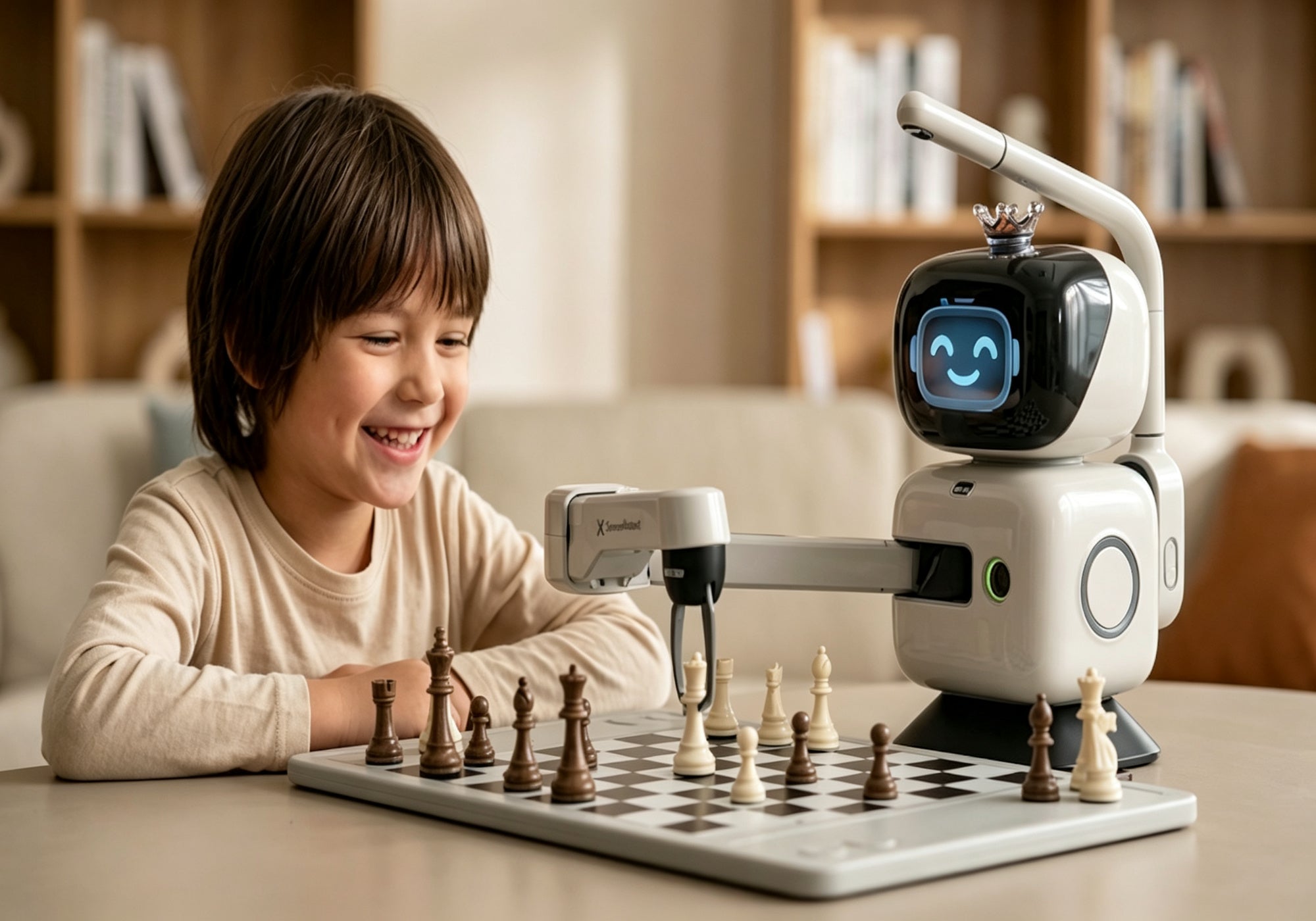
SenseRobot AI Chess Robot on its introductory settings (starting at Elo 200), the system intentionally simulates a human novice, leaving room for simple tactical mistakes to help build a beginner's confidence. However, when scaled up to its elite Level 25 (Elo 2900) or the ultimate Apex Duel mode (Elo 3200), it calculates with superhuman precision, flawlessly seeing multiple moves ahead with zero tactical blind spots.
For human context, Magnus Carlsen’s peak Elo is 2882, the highest rating in human history according to FIDE official records. Our step-by-step guide to raise your chess Elo rating breaks down exactly how long it takes amateur players to reach comparable milestones. While today’s top research engines can exceed 3500 on a raw scale, consumer AI chess robots are expertly capped at 25 training levels ranging up to Elo 2900 to perfectly match human scaling. This creates a highly intuitive learning curve that mirrors how a human child progresses, just incredibly accelerated.
The Five Key Bands
· Elo 200–600 (Levels 1–5): The Gentle Novice. The robot intentionally restricts its search capabilities to safely simulate human beginner play. It makes deliberate, teachable mistakes, allowing young children to build confidence while learning basic rules and piece values.
· Elo 700–1400 (Levels 6–9): The Tactical Sparring Partner. SenseRobot begins to actively utilize shallow neural network evaluations to spot basic forks, skewers, and two-move checkmates. It starts punishing obvious blunders, gently forcing students to pay closer attention to immediate board threats.
· Elo 1500–2200 (Levels 10–16): The Advanced Club Player. Deep neural network pattern recognition is fully unleashed. The physical robot actively evaluates complex positional space and pawn structures without needing exhaustive search, providing a rigorous challenge that surpasses most casual adult players.
· Elo 2300–2700 (Levels 17–22): The Master Tactician. The system fully integrates flawless endgame calculations and ultra-deep search algorithms. SenseRobot begins to dominate in complex, piece-scarce scenarios, pushing highly competitive students to refine their endgame precision.
· Elo 2800–2900 (Levels 23–25): The Superhuman Apex. At its highest built-in settings, SenseRobot achieves near-perfect play with zero tactical holes. For the ultimate test, it even features an unlocked Apex Duel mode arriving Elo 3200, pushing far beyond the limits of human capability.
The AI Training Ladder: How Engines Climb Through 25 Levels
Answer first: AI chess training is not just about raw computing power; it is about flawlessly scaling that intelligence to match human learning. While purely academic software took decades to reach superhuman status, the
SenseRobot AI Chess Robot compresses this entire evolutionary timeline into 25 highly accessible, physical training tiers. It brilliantly bridges the gap between complex digital algorithms and tactile, over-the-board play.
Historically, bridging the massive rating gap between a strong club player and a superhuman entity required massive supercomputers and years of algorithmic refinement. Today, SenseRobot places this exact sophisticated trajectory directly into your living room. By seamlessly managing search depths and advanced neural networks, the system can instantly transform from a Elo 200 absolute beginner into a Elo 2900 grandmaster. This dynamic scaling proves that elite chess improvement requires smart, adaptive hardware rather than just a faster tablet processor.
The Five Technical Milestones of SenseRobot
· Elo 200–600 (Levels 1–5): The Gentle Novice. The robot intentionally restricts its search capabilities to safely simulate human beginner play. It makes deliberate, teachable mistakes, allowing young children to build confidence while learning basic rules and piece values.
· Elo 700–1400 (Levels 6–9): The Tactical Sparring Partner. SenseRobot begins to actively utilize shallow neural network evaluations to spot basic forks, skewers, and two-move checkmates. It starts punishing obvious blunders, gently forcing students to pay closer attention to immediate board threats.
· Elo 1500–2200 (Levels 10–16): The Advanced Club Player. Deep neural network pattern recognition is fully unleashed. The physical robot actively evaluates complex positional space and pawn structures without needing exhaustive search, providing a rigorous challenge that surpasses most casual adult players.
· Elo 2300–2700 (Levels 17–22): The Master Tactician. The system fully integrates flawless endgame calculations and ultra-deep search algorithms. SenseRobot begins to dominate in complex, piece-scarce scenarios, pushing highly competitive students to refine their endgame precision.
· Elo 2800–2900 (Levels 23–25): The Superhuman Apex. At its highest built-in settings, SenseRobot achieves near-perfect play with zero tactical holes. For the ultimate test, it even features an unlocked Apex Duel mode arriving Elo 3200, pushing far beyond the limits of human capability.
The Ultimate 25-Level Training Partner: SenseRobot AI Chess Robot
While software engines are powerful, experiencing these 25 levels on a physical board is the ultimate way to train. The
SenseRobot AI Chess Robot brings this exact 25-tier Elo progression—seamlessly scaling from a beginner-friendly Elo 200 up to a superhuman Elo 2900—directly into your living room.
Rather than tapping on a flat screen, players interact with an aerospace-precision robotic arm. The engineering is unparalleled: featuring 99.9% AI vision accuracy and over 30 built-in safety sensors, the robotic gripper is so precise and gentle that it can handle a fragile quail egg without cracking it.
Beyond raw calculation, SenseRobot is not just a cold machine. It features versatile conversational AI that offers real-time voice encouragement and companionship, transforming abstract Elo data into a warm, engaging study buddy. Backed by over 140,000 global sales and strategic partnerships with ECU, it is the premier, data-driven choice for all chess enthusiasts and children.
Practical Takeaways for Parents and Enthusiasts
Answer first: Understanding these 25 AI levels helps parents and amateur players set realistic goals, pick the right training partners, and diagnose specific skill gaps. Because the AI progression mirrors human learning, it serves as the ultimate, objective diagnostic tool.
Online platforms and physical smart boards offer adjustable opponents that scale perfectly with your ongoing progress. For example,
if your child is rated Elo 1200 and can consistently hold their own against an AI set to 1200, they have mastered that tier's tactics. If they struggle, it is a clear, undeniable signal to drill specific puzzles. You can find more information in
How AI Chess Robots Help Kids Learn Chess Faster.
Consider a real-world case: a 10-year-old plateaued at Elo 1200 for three agonizing months. By analyzing his games against an adaptive AI, his parents noticed he consistently missed forks common in the 1000–1400 range. After just two weeks of targeted daily tactical puzzles, his rating jumped to 1350.
Three Actionable Tips
· Match Training Difficulty: Play against an AI that is Elo 50–100 stronger than you. Too easy leads to boredom, while too hard causes unnecessary, counterproductive frustration.
· Identify Bottleneck Levels: Stuck at Elo 1200? You likely lack tactical pattern recognition and should drill puzzles. Stuck at 1800? You need to focus on deep positional understanding and pawn structures.
· Create a Level-by-Level Roadmap: Set monthly, highly achievable goals, such as moving from 1000 to 1200 in 30 days. Plan specific drills for your current tier and celebrate every level-up.

FAQs
Q: Is it possible for a human to reach Elo 2900 like an AI?
A: No. The highest human rating ever officially recorded is 2882 by Magnus Carlsen. An AI at 2900 or above never tires, never blunders, and calculates perfectly, whereas humans are always bound by biological limits and fatigue.
Q: What is the best AI level for a beginner child (Elo 800)?
A: Start with AI levels mapped to roughly Elo 800–1000. Avoid setting engines to grandmaster levels immediately, as getting repeatedly crushed will quickly destroy their motivation.
Q: Why does my Elo 1500 AI opponent sometimes make silly mistakes?
A: Low-level AI engines are intentionally handicapped—they search fewer moves deep to safely simulate human error. These programmed mistakes mimic real-world amateur blunders, which actively helps you learn how to spot and punish actual inaccuracies.