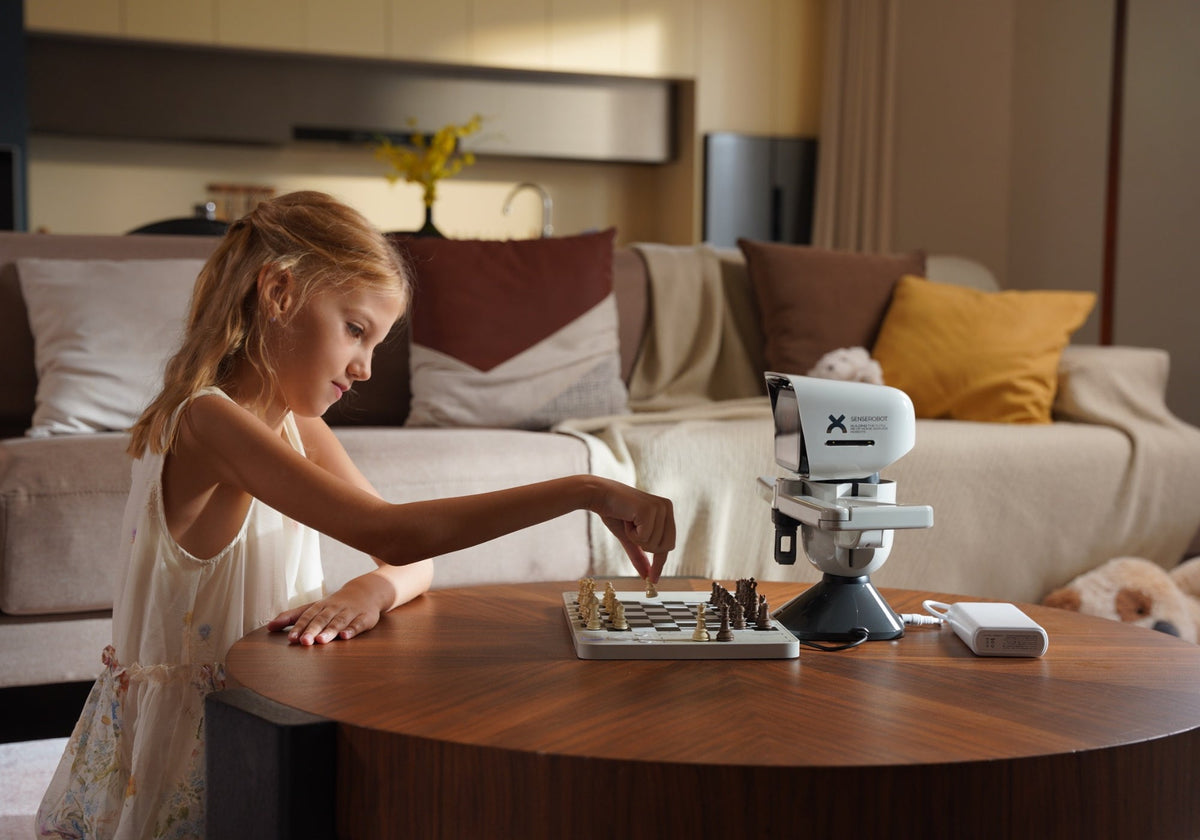

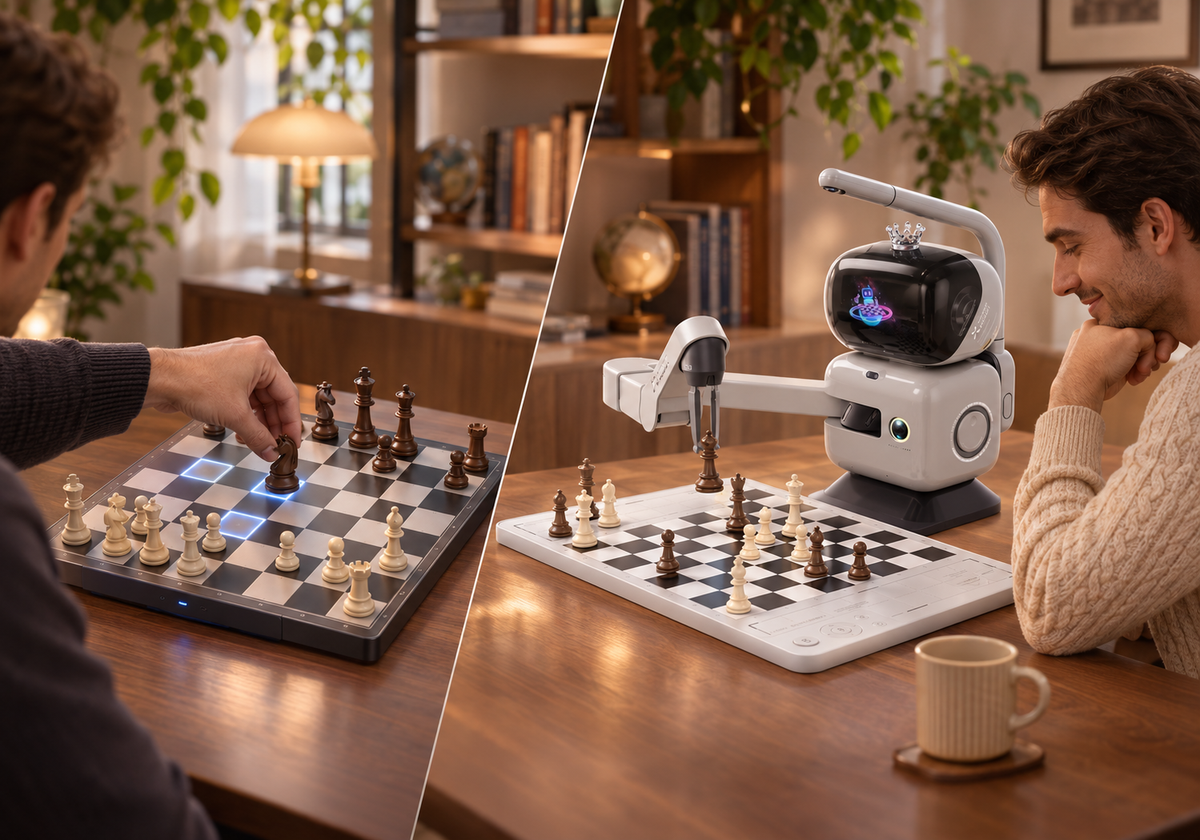
Two products can both be described as an electronic chess board while providing very different experiences. On one board, lights show the opponent’s move and you move the piece yourself. On another, the opponent’s reply physically happens across the board.
Both may recognize moves, connect to an AI engine and support online play. The difference affects the price, playing speed, space required and how closely the game feels like sitting across from another player. Looking more closely, self-moving electronic chess boards can be further divided into three types: under-board magnetic mechanisms, motorized chess pieces, and AI vision chess boards with robotic arms.
The most useful question is simple: does the board show the opponent’s move, or physically play it?
The Main Difference: Who Moves the Opponent’s Pieces?
An LED-guided board recognizes your move and shows the reply with lights or a display. You then move the opponent’s piece.
A self-moving chess board goes one step further. After recognizing your move, it physically executes the reply using a magnetic mechanism, motors inside the pieces or a robotic arm.
|
Decision point
|
LED-guided board
|
Self-moving board
|
|
Shows the opponent’s move
|
LEDs or a display
|
May also use LEDs or a display
|
|
Physically plays the reply
|
No
|
Yes
|
|
Who moves the opponent’s piece?
|
The player
|
The board or robot
|
|
Main advantage
|
Speed, portability and lower cost
|
Physical opponent response and automation
|
|
Common tradeoff
|
You operate both sides
|
Higher cost, more space and mechanical complexity
|
|
Usually suits
|
Recording, blitz and online input
|
Rapid, classical and physical AI play
|
Some self-moving boards also have LEDs. The defining difference is therefore not whether the board has lights. It is whether the system physically completes the opponent’s move.
LED-Guided Electronic Chess Boards
An LED chess board keeps the familiar structure of a normal game but adds move recognition and digital guidance. It recognizes your move and uses illuminated squares to show the reply from an AI or online opponent. You then move the opponent’s piece by hand.
Recognition varies by model. Basic boards detect occupied squares, while full-piece recognition boards identify each piece, making game recording, position recovery and analysis easier.
This type is a practical choice if you prioritize:
- Faster time controls such as blitz
- Lower cost and easier portability
- PGN recording and game analysis
- Online play with a physical board
- A traditional or tournament-size design
However, product terminology can be confusing. “AI-powered,” “automatic” or “smart” does not necessarily mean the pieces move. Automatic recording, automatic analysis and automatic piece movement are three separate functions.
Self-Moving Electronic Chess Boards
A self-moving electronic chess board recognizes the player’s move and physically executes the reply from an AI or online opponent.
There are three main ways to achieve this. Each solves the same problem, but the resulting movement, maintenance and playing experience differ.
Under-Board Magnetic Systems
An under-board magnetic system places a motorized carriage or small moving mechanism beneath the playing surface. Magnets connect the hidden mechanism to the chess pieces, allowing the pieces to slide from one square to another.
The main advantage is appearance. The mechanism remains out of sight, so the board can preserve a clean, traditional shape. Watching pieces glide across a wooden board also creates a distinctive visual effect.
This design still involves practical questions. Pieces need a clear route across the surface, especially in crowded positions. Captures require the system to move the captured piece away before completing the reply. Knights, castling and other multi-step movements may also require additional path planning.
Before buying this type of self-moving chess board, check:
- Whether pieces must be carefully centered
- How it navigates crowded positions
- Whether movement speed can be adjusted
- How much noise the internal mechanism produces
- Whether only the supplied magnetic pieces are compatible
- How the board recovers if a piece loses contact with the mechanism
This type suits buyers who want hidden automation and prefer the board itself to remain visually close to a conventional chess set.
Motorized Chess Pieces
A newer approach places the movement system inside each chess piece. Instead of one mechanism moving beneath the board, the individual pieces can drive themselves across the surface.
This design can allow several pieces to move at the same time. That is useful when resetting the board, building a custom position or preparing a puzzle with many pieces.
The convenience comes with different ownership considerations. The pieces are specialized electronic components rather than ordinary chessmen. You should check how they charge, how long the batteries last and what happens if a single piece is lost or damaged.
Important questions include:
- Can replacement pieces be purchased separately?
- Do the motorized bases change the weight or feel of the pieces?
- Can pieces move reliably in a crowded position?
- How accurate is simultaneous multi-piece movement?
- Does the system require a dedicated charging surface?
A board with motorized chess pieces may suit players who frequently set up exercises, endgames or custom positions and want the system to rearrange several pieces automatically.
AI Vision and Robotic-Arm Systems
Unlike under-board magnetic systems and motorized chess pieces, a robotic-arm chessboard solves the same challenge via an above-the-board mechanism while prioritizing user experience.
A camera or vision system reads the position. The AI or online platform determines the opponent’s reply. A mechanical arm then reaches over the board, picks up the correct piece and places it on the destination square.
SenseRobot belongs to this category. We use AI vision to recognize the board position and a robotic arm to execute the opponent’s move. Instead of dragging pieces with a hidden magnetic carriage or placing motors inside every piece, the arm picks up and places the appropriate piece from above.
The visible action is the main experiential difference. The opponent’s reply does not appear only as illuminated squares or a piece sliding on its own. The arm reaches for the piece, lifts it and plays the move in front of you.
You can read more about how computer vision recognizes the board and how SenseRobot’s robotic arm works.
How the Three Self-Moving Systems Compare in a Real Game
A mechanism can look impressive in a demonstration, but the better buying test is a complete game. Consider what happens during an ordinary reply, a capture, a special move and a position correction.
|
Difference
|
Under-board magnetic
|
Motorized pieces
|
AI vision and robotic arm
|
|
Movement source
|
Under the board
|
Inside each piece
|
Above the board
|
|
Piece movement
|
Slides across the surface
|
Drives across the surface
|
Picked up and placed
|
|
Main visual effect
|
Hidden movement
|
Pieces move independently
|
Visible opponent action
|
|
Special hardware
|
Magnetic pieces
|
Motorized pieces
|
Vision system and robotic arm
|
|
Main appeal
|
Clean board appearance
|
Automated multi-piece setup
|
Face-to-face physical rhythm
|
Capabilities vary between products, so do not assume every self-moving board handles castling, promotion, en passant, captures or automatic reset in the same way.
Magnetic systems emphasize hidden movement and a clean board. Motorized pieces can make multi-piece setup more efficient. A robotic arm emphasizes the visible act of an opponent picking up and placing a piece.
Where SenseRobot Fits Among Self-Moving Boards
SenseRobot’s main difference is not simply that it is automatic. Magnetic systems and motorized pieces can also move without the player completing the reply.
Its distinction lies in combining AI vision with a visible robotic arm. The system reads the physical position, identifies the intended move and then reaches over the board to pick up and place the piece. Our vision system achieves more than 99.9% recognition accuracy and converts board information into millimeter-level robotic control.
This design addresses several specific needs:
- The player does not need to move the AI or online opponent’s pieces.
- The opponent’s response becomes a visible physical action.
- The pieces are lifted rather than dragged across the playing surface.
- The arm approaches crowded positions from above.
- The same physical board can support AI games, structured practice and compatible online play.
- A suitable opponent is available without coordinating another person’s schedule.
The movement experience is only part of the ownership decision. Adjustable AI levels, exercises, endgames, classic games and online platform support determine whether the board fits the player’s longer-term routine.
SenseRobot models differ in their regular AI ladders, online platform support, physical size and family-oriented features.
Choose the Board Around the Move Experience You Want
The first comparison tells you whether you want manual guidance or automatic movement. The next step is to choose among the four move experiences discussed in this guide.
|
Move type
|
Start here when
|
Check before buying
|
|
LED-guided
|
You prioritize speed, portability, lower cost or PGN recording and do not mind moving both sides
|
Recognition method, platform support and LED visibility
|
|
Under-board magnetic
|
You want hidden automation and a board that keeps a traditional appearance
|
Capture handling, movement paths, centering, noise and compatible pieces
|
|
Motorized pieces
|
You want independent piece movement or frequent automatic position setup
|
Charging, replacement pieces, battery life and movement accuracy
|
|
AI vision and robotic arm
|
You want the opponent’s piece to be visibly picked up and placed across the board
|
Arm clearance, stable setup, playing speed and platform support
|
For online games, confirm whether the board connects natively, through a companion app or through a browser extension. A product may support the same platform through a very different setup process.
Time control also matters. An LED-guided board can display a reply almost immediately, while every self-moving system needs time to complete a physical action. LED-guided boards therefore have a practical advantage in blitz. Self-moving systems are generally better matched to rapid and classical games, where the physical response is part of the experience.
SenseRobot Chess currently centers its online experience on Lichess. Chess Mini supports Lichess and adds Chess.com through ChessConnect. The connection process is covered in our guide to playing online chess on a physical robotic board.
Conclusion
Start with the move experience you want.
If you are comfortable moving both sides, an LED-guided board offers a practical balance of speed, portability and game recording. Choose an under-board magnetic system if you want hidden automation. Consider motorized pieces when repeated automatic position setup is important. For a more visible and engaging response, an AI vision system with a robotic arm can physically pick up and place the opponent’s pieces.
SenseRobot brings this last experience to life. Its flexible robotic arm picks up and places real pieces with approximately 1 mm accuracy, creating a rhythm that feels closer to playing across the table from another person. AI vision, precise positioning and a controlled, gentle grip work together to support safe and immersive play.
If you want an electronic chess board that responds physically instead of only lighting up the next move, compare the available SenseRobot models.