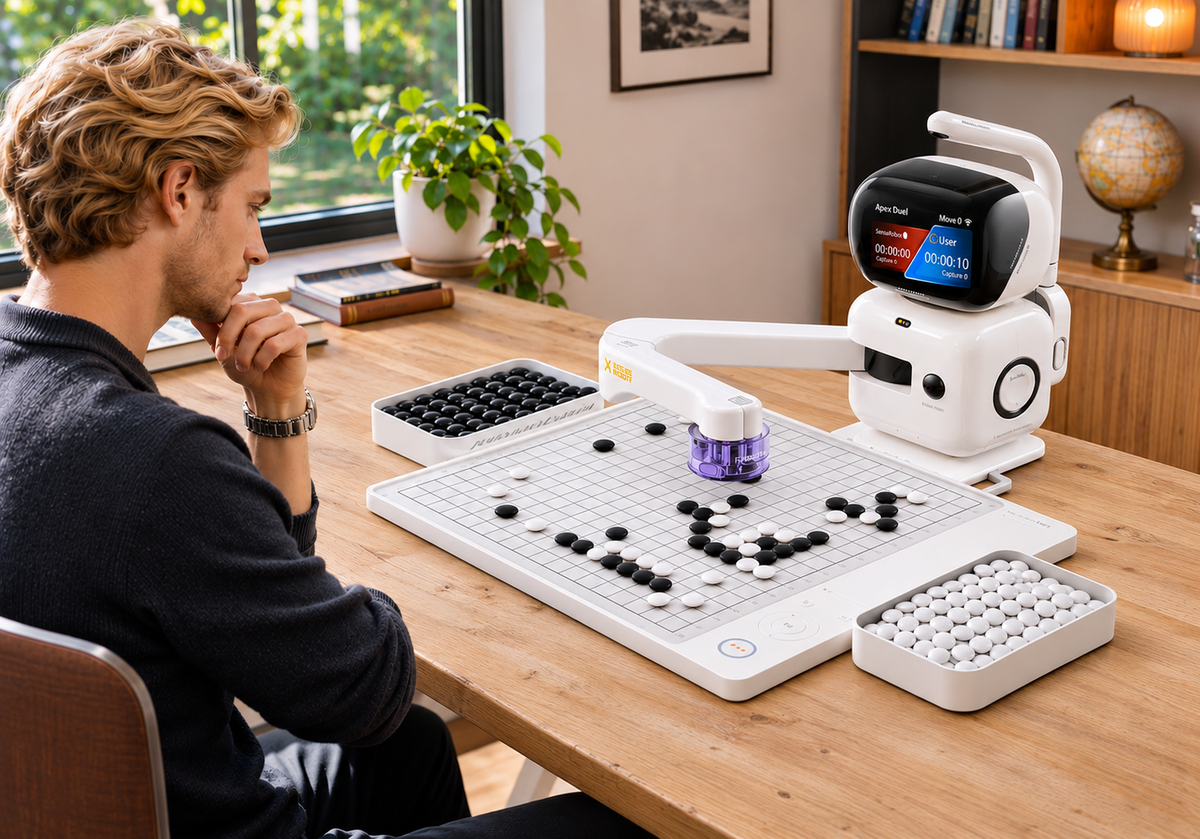

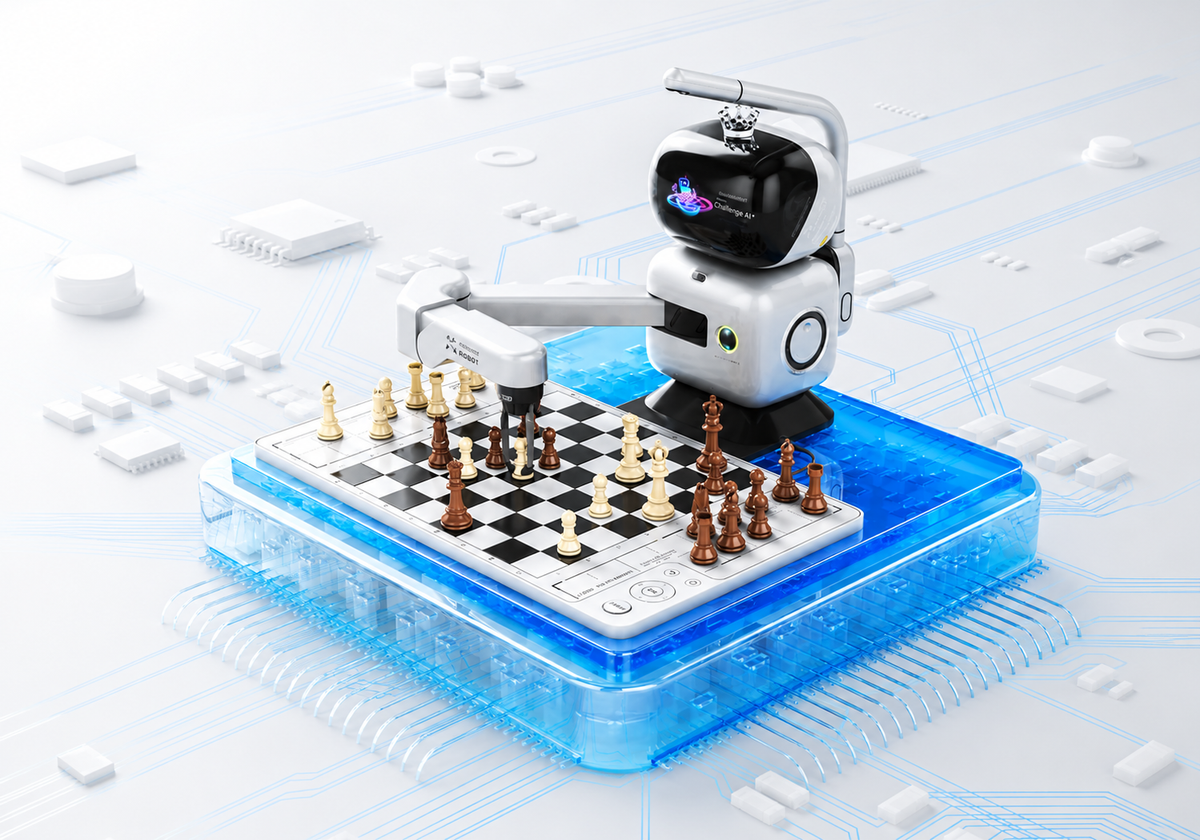
Smart chess boards combine the familiarity of real pieces with digital opponents, game tracking, and training tools. But how does a board recognize your move, choose a reply, and move a piece in response? This guide explores the technologies behind these capabilities, then shows how SenseRobot brings AI vision, chess decision-making, and robotic arm control together to create a physical playing experience for beginners and experienced players alike.
What Makes a Chess Board Smart?
A smart chess board turns physical piece movements into digital game data, connecting play on the board with software for recording, analysis, or connected opponents.
The International Chess Federation (FIDE) requires tournament electronic boards to recognize piece placement, support move recording, and transmit moves to a control system. These requirements highlight the link between a physical position and its digital record.
For everyday players, that connection supports three practical functions:
- Automatic tracking: capture moves as you play with physical pieces.
- Game review: save a game so you can revisit positions and analyse decisions using compatible software.
- Connected play: use the board with supported chess engines or online platforms.
Smart chess boards connect the physical position with a digital game. Self-moving models complete that connection by executing the opponent’s reply on the board, allowing you to follow each turn through real pieces and visible movement.
How Do Self-Moving Chess Boards Work?
Self-moving chess boards combine position recognition, a digital move source, and automated movement to turn an AI or remote opponent’s reply into a physical action.
Current designs use several movement technologies. Some pull pieces magnetically from beneath the board, some place motors inside the pieces, and others use vision with a robotic arm. In each case, the system must connect the digital move with the correct physical piece and destination.
|
Technology
|
How It Works
|
What the Player Experiences
|
|
Under-board magnetic movement
|
A mechanism beneath the playing surface uses magnetic attraction to move pieces according to digital instructions.
|
The opponent’s pieces travel across the squares automatically.
|
|
Individually motorized pieces
|
Motors and wheels inside individual pieces execute movement instructions.
|
Pieces move across the board under their own power.
|
|
AI vision and robotic arm control
|
A vision system identifies piece positions; an arm grasps, lifts, and places the selected piece.
|
The player sees the opponent’s reply unfold through a visible pickup, transfer, and placement.
|
The differences extend beyond how pieces move to the underlying recognition technology, AI algorithms, and coordination between software and hardware. Recognition supplies the position, the chess engine determines the challenge at the selected difficulty, and movement control brings the response onto the board.
SenseRobot connects AI vision, chess decision-making, and robotic arm control to bring human–AI play into the physical world. The AI’s decision becomes visible as the arm reaches for a piece and completes its move. That sequence gives players a tangible response to study and a turn-taking rhythm that feels like facing an opponent across the board.
How Does SenseRobot Technology Connect Vision, Decisions, and Movement?
Our SenseRobot Technology connects visual recognition, AI decision-making, and robotic arm movement to carry a game from your move through the opponent’s physical reply. Watch the video below to see how our AI robotic chess board recognizes a player’s move and responds by picking up, moving, and placing a piece.
How Does SenseRobot Recognize Your Move?
SenseRobot uses AI vision technology to identify piece positions and read the board after your move. Its high-precision vision system recognizes chess pieces in real time across different shapes, sizes, and positions, achieving a recognition rate of over 99.9%.
When the knight moves from g1 to f3, the perception stage supplies information about the resulting position. The chess software then has a position from which to continue the game.
This connection matters during practice because your attention can stay with physical squares and pieces. A parent can ask a child to explain the knight’s new targets while both look at the same position.
How Does the Chess Engine Choose a Reply?
During an AI game, SenseRobot Chess generates its reply from the current position at the difficulty you select. SenseRobot Chess offers 25 AI levels spanning Elo 200–2900, plus an Apex Duel mode specified at Elo 3200. The range gives beginners a starting point and experienced players a way to increase the challenge.
For a useful practice routine, choose a level at which you can finish games and explain your decisions. Work on one task, such as checking for undefended pieces, before raising the difficulty.
During online games, the reply comes from the remote player through Lichess. The system receives that move, and the arm carries it out on your board.

How Does the Robotic Arm Turn a Move into Action?
The control system converts the selected reply into grasping, moving, and placing the corresponding piece. Take our SenseRobot Chess for example, it features an innovative mechanical structure and algorithm specifically developed for its robotic arm, equipped with a three-fingered gripper for precise handling of 3D chess pieces.
In our opening illustration, visual information establishes where the pieces are, while movement control directs the physical pickup and placement. This is the role of hand-eye coordination: connecting recognized locations with actions in the same physical space. Powered by an advanced visual algorithm, SenseRobot translates what it "sees" into precise action.
For players, humanlike meanss the visible handling of pieces and the rhythm of taking turns. You observe the pawn arrive, reassess the position, and prepare your response. By continuously analyzing each chess piece’s position, shape, and movement in real time, the robot converts visual information into millimeter-level motor control. This coordination enables it to track, target, and handle pieces with smooth, humanlike movements, even during rapid gameplay.
What Does SenseRobot Technology Bring to Your Game?
SenseRobot combines AI vision, chess decision-making, and robotic arm control to give players a responsive opponent on a physical board. Vision recognizes the position, the AI engine selects a reply, and the robotic arm turns that decision into a visible move.
For beginners, selectable difficulty levels, move hints, and takebacks provide ways to practise and reconsider decisions. Experienced players can choose stronger opponents and work through endgame challenges, keeping their practice grounded in real positions and physical pieces.
Across skill levels, the experience follows a familiar rhythm: study the board, make your move, watch the reply, and think again. Explore our robot chess boards to bring that interaction into your everyday practice and feel the raw intensity of a true back-and-forth exchange.