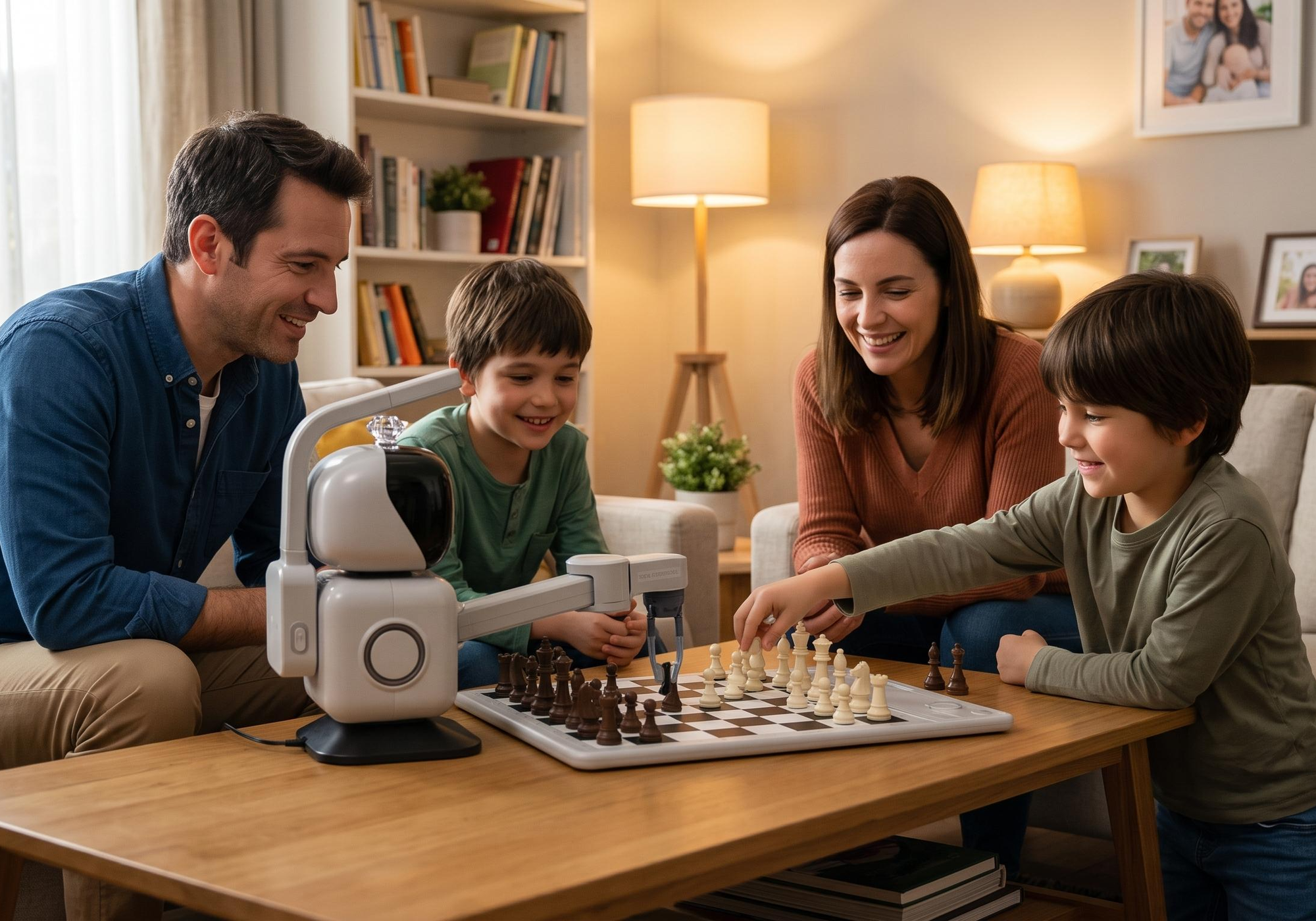

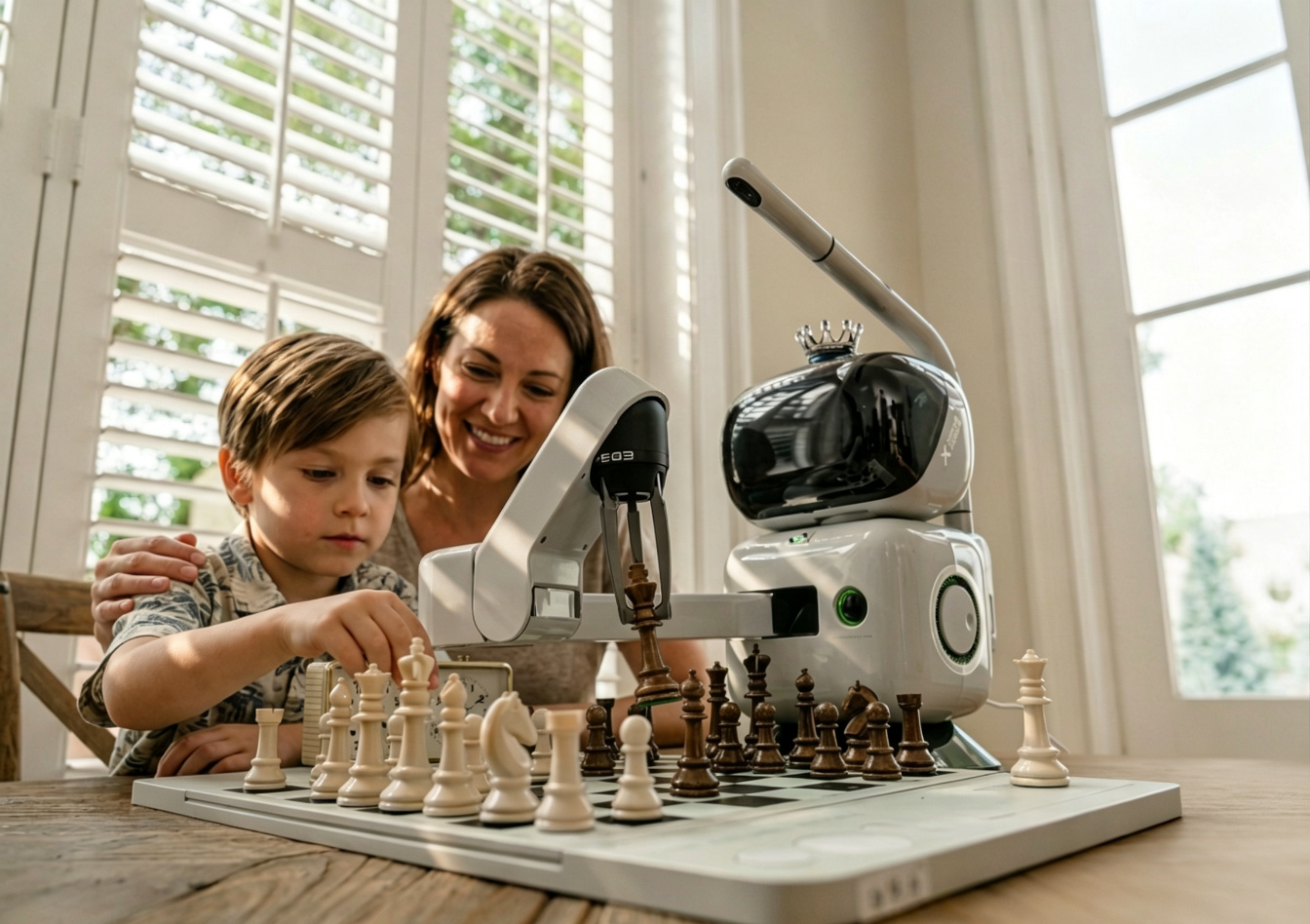
Are you searching for a tool that genuinely challenges your child's developing mind away from passive screens? An AI chess robot for children might be the most impactful educational investment you haven't made yet. While the cognitive benefits of chess are universally recognized, traditional tablet apps and weekly group lessons often fall short of keeping kids consistently engaged. A smart robotic chessboard changes the equation by providing a personalized, pressure-free opponent that physically moves pieces and grows alongside your child. Let's explore how this technology builds mental muscle and life skills that extend far beyond the 64 squares.
Quick Summary
Builds Critical Cognitive Skills: It acts as a tireless tutor, directly enhancing your child's strategic foresight, problem-solving capabilities, and patience through tangible, hands-on play.
Offers Personalized Learning: Unlike static group classes, users can adjust its difficulty to match child's exact skill level, keeping them perfectly challenged without frustration.
Provides Hassle-Free Practice: Finding time for weekly coaching sessions can be a logistical nightmare. A home chess coach offers 24/7 availability with zero scheduling required, guaranteeing consistent learning.
For a complete overview of the AI chess robot landscape, check out our Ultimate Guide to AI Chess Robots.
Beyond the Board: Cognitive & Educational Benefits
Playing against a physical AI chess robot for children creates an immersive, distraction-free environment that challenges a child's mind at precisely the right level. Every move serves as a direct lesson in consequences, helping children visually internalize the "if-then" logic fundamental to mathematics and coding. They learn to think several steps ahead, carefully weighing options before committing to an action. Over time, this calculated approach translates into better real-world decision-making and academic stamina.
Unlike fast-paced video games, physical chess demands deep, sustained focus and memory recall. The U.S. Chess Federation highlights studies showing that students in chess programs consistently achieve higher scores on standardized tests.
Furthermore, interacting with a robotic arm demystifies modern technology for curious minds. Organizations like the Kasparov Chess Foundation champion chess as a natural gateway to STEM education, making these smart boards the ultimate tactile learning tool.
The Perfect Partner: Adapting to Your Child’s Pace
The true magic of a smart chess board lies in its bespoke, highly adaptive learning journey. The educational experience starts exactly where your child currently is, completely removing the intimidation factor.
SenseRobot feature 25 built-in difficulty levels, seamlessly scaling from a beginner-friendly 200 Elo up to a staggering 2900 Elo. This dynamic adaptation keeps students in the optimal zone of learning—never bored and never overwhelmed.
SenseRobot feature 25 built-in difficulty levels, seamlessly scaling from a beginner-friendly 200 Elo up to a staggering 2900 Elo. This dynamic adaptation keeps students in the optimal zone of learning—never bored and never overwhelmed.

There is no need to wait for next week's coaching session to understand why a specific move failed. The robot provides real-time feedback and offers strategic nudges via its built-in chess teaching systems. With access to over 1,200 curated interactive exercises, kids can drill specific endgames or opening traps at any time. Best of all, this industrial-grade technology is packed into a consumer robot that costs just 1/75 of traditional robotic systems.
More Than a Game: Fostering Life Skills
Beyond mastering the rules of the board, regular engagement with an AI chess robot cultivates essential, lifelong habits. Losing to a non-judgmental machine allows children to analyze their missteps privately and try again without fear of embarrassment. This emotionally safe space is absolutely crucial for building long-term resilience and a healthy relationship with failure. It naturally teaches children that progress comes directly from consistent practice rather than innate talent.
In an era dominated by passive scrolling, parents are desperate for healthier digital alternatives. An AI chess robot delivers deep, focused engagement that actually builds cognitive architecture rather than simply consuming attention. Far from being an isolating gadget, the physical board frequently becomes a magnetic centerpiece for the whole family. It creates shared moments of laughter and strategic thinking, making it the perfect addition to your family game nights.

Conclusion
Investing in an AI chess robot for children is far more than just purchasing a new toy; it is securing a tireless, brilliant learning partner. It merges the time-tested cognitive benefits of chess with the unmatched precision and adaptability of modern robotics. SenseRobot has already sold over 140,000 units globally and earned public endorsements from legends like Women's World Chess Champion Hou Yifan,Women’s World Chess Champion Antoaneta Stefanova and Bodhana Sivanandan, the 10-year-old prodigy and Woman International Master. Are you ready to ditch the passive screens and revolutionize how your family plays and learns? Bring a smart chess robot into your home today!
Frequently Asked Questions (FAQ)
Q1: At what age is it appropriate to introduce my child to an AI chess robot for children?
Most children can successfully start engaging with a simplified, interactive robot around age 5 or 6. At this age, they are fully capable of grasping basic rules like piece movement and taking turns. By utilizing the robot's lowest difficulty settings and built-in voice guidance, the experience feels like a fun, low-pressure game rather than an academic lesson.
Q2: How does an AI chess robot differ from a regular chess app on a tablet?
The core difference lies in the tactile engagement and the physical presence of the board. A physical robot provides a hands-on experience that dramatically improves focus and mimics the feeling of playing a real human opponent. Furthermore, advanced AI robots feature industrial-grade hardware, like 30+ built-in sensors that make the robotic gripper incredibly safe for kids to use. What's more, if children are going to participate in competitions or real-life games, using real chessboards and pieces will better enhance their competitive abilities.
Q3: Are these robots suitable for complete beginners with no chess knowledge?
They are absolutely perfect for complete beginners starting entirely from scratch. Premium AI chess robots are specifically designed to teach the game from the ground up without causing frustration. Taking SenseRobot Chess as an example, we have built-in introductory and beginner courses, totaling 25, which are fully suitable for users with no chess experience.